Thursday, October 24, 2013

Sen Monorom Park


It's a bit of a stretch to call this a park, it's just a small triangle at the junction of Russian Federation and Monivong Boulevards. I'm not sure I've ever seen anyone actually using it as a park, it's just ornamental. Previously it was the site of a rather tired-looking PTT gas station, as you can see in the middle picture that was taken during Khmer New year, in April 2010. The gas station had existed for decades, in the background you can see the Canadia Bank Tower, which had only recently been completed and was at that time the tallest structure in the city. The bottom picture shows the fencing surrounding the statue of Ganesh that was mainly carved in-situ, it was taken in December 2011. The top picture shows the park as it appears today, with the almost finished Vattanac "boot" tower behind which dwarfs the Canadia tower in the foreground, it's at least 100 meters taller. It doesn't look a lot larger in the picture, but is actually quite a bit higher. The small park does certainly look a lot prettier than it did when the service station was there, although the statue to me is rather blocky in shape and lacks the natural flow and smooth curves which most ancient Cambodian statuary has. It's still a vast improvement on the previous garage.

Thursday, September 5, 2013

Ting Mong

These are what appear to be scarecrows commonly seen in the northern part of the country, but aren't used to scare crows, but to scare away evil spirits. They are often armed with fake machetes, guns or even rocket launchers.
 A friend took this picture in Kampong Thom province. What's unusual about this one is the "appendage" between its legs.

For more, check here: Insanely creepy Cambodian scarecrows

Wednesday, September 4, 2013

Isolated Villages

Poom Kompong Roteah is a small village that is probably only 40 km from the city center. To get to it, you have to drive north on National Route 5, almost to Oudong, but then just past the new Prek Kdam bridge take a small turn off to the right along an unsurfaced, muddy and rutted road. A few kilometers later you have to get a small boat across the Tonle Sap river to the village.
I've been there a few times over the years, and little has changed. I'd say it's quite typical of many of the small isolated villages away from any main roads in the countryside. The one "road" running through the village doesn't connect with the Prek Kdam bridge, so that's why you need to take a boat.
Nobody has a car there, and on my last visit I was there for about 4 hours and saw one motorbike and one ox-cart go past. There isn't much or any money around, the people survive on subsistence farming, fishing and the odd bit of generosity from relations in the capital. When I checked the local shop they had barely anything to sell, the ice-chest had a few of those silver-packaged sweet drinks in it and a few jars of preserves. There was no ice in there.
What I found interesting was the construction of some of the houses. I have relations there, and the village evacuated to the Phnom Da area in the early 70's because of heavy fighting in the area, and then eventually had to move to the capital as the fighting drew closer to the city.
Some of the houses have concrete pilings and elaborate stairways that were obviously the bases of much nicer dwellings before the war destroyed them. Now they have woven structures on top, the cheapest building material available. One you can see in the pictures was built on the ground under the pilings, a very unusual arrangement in an area that sees regular flooding in the rainy season.


Thursday, January 17, 2013

Wat Sarawan

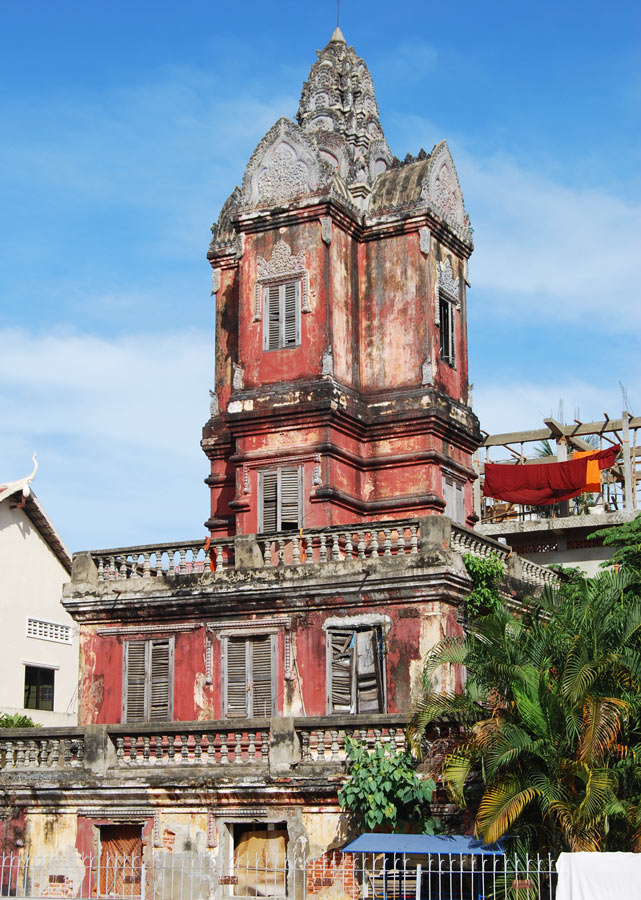
Said to be one of the five original pagodas in Phnom Penh, in common with the other ones there are few original buildings in the compound. The nearby Wat Ounalom was supposedly inaugurated in 1443, but there appear to be few if any buildings that are more than a century old, and most are far more modern. Wat Sarawan is remarkable in that it contains what are arguably the most ancient Buddhist scrolls in the country. Written on parchment, these religious texts tend to decay in the tropical climate and a great many were destroyed or lost during the tumultuous years of the past few decades.
One striking structure that remains on the site is a red brick tower that appears to be particularly ancient. The Serge Corrieras photograph of children playing in front of it in 1991 shows it looking on the verge of collapse. What is even more surprising is that in 2012 this building which was obviously refurbished in the subsequent years looks even older now. The colonial-style slatted windows are falling apart. As far as I know it is only about one hundred years old but one would be easily fooled into thinking it is much more ancient.


Tuesday, January 8, 2013

January 7th 1979

Psah Thmei in December 1978 by Elizabeth Becker


PAVN/KUFNS troops entering Phnom Penh


PAVN/KUFNS troops entering Phnom Penh
Troops in front of the Royal Palace


A deserted street near O'Russei Market with abandoned Vespas

A deserted Charles de Gaulle Boulevard


Near Psah Thmei


Abandoned cars near Tuol Kok Antennae

Children found near Tuol Sleng

Children found near Tuol Sleng

Citizens returning to the city

Citizens waiting to enter the city. At first the new government tried to control entry.

After numerous incursions and massacres by Pol Pot's troops inside the Vietnamese border in 1977 and 1978 the Vietnam People's Army (PAVN) , along with the Kampuchean United Front for National Salvation (KUFNS) launched their invasion of Democratic Kampuchea on December 25th 1978. They encountered little resistance, and managed to liberate Phnom Penh on 7th January 1979. 
 

Friday, December 21, 2012

Wat Phnom Plaque


This plaque on the southern slope of the hill commemorates the return of the western provinces of Battambang, Siem Reap and Sisophon to Cambodia after the 1907 Franco-Siamese treaty. The three women on the right side represent the three provinces, while in the middle sits King Sisowath. The first picture is from 1931, and shows a woman by the plaque on a barren-looking hill. Nowadays the gardens receive quite a bit more attention and foliage abounds.